Pay to Play: The Football Career of Colonel Gaddafi’s Son
- Jack Curson
- Jul 25, 2025
- 14 min read

Updated: Jul 26, 2025
Jack Curson

Muammar Gaddafi ruled Libya with an iron first for over 40 years, seizing power in a military coup in 1969 and finally being captured, tortured and killed at the hands of his own people during the Libyan civil war. Gaddafi was a self-styled anti-imperialist who began his rule by passing a range of reforms which included the creation of social welfare programs, the expansion of women’s rights and the nationalisation of the country’s oil industry. However, his leadership soon descended into one of brutal repression internally and unrestrained violence abroad, with Gaddafi’s name now largely associated with the financing of international terrorism and the suppression of the Libyan people, rather than any progress achieved in the early years of his rule.

Gaddafi had a total of eight biological children, many of whom were involved in Libyan politics and one of whom served in Saddam Hussein's legal defence team following the toppling of his regime. However, none have as spectacular a story as his third son Saadi. Saadi was born in 1973 and gained an international reputation for his playboy lifestyle, with a leaked 2009 US diplomatic cable describing him as the ‘black sheep’ of the Gaddafi family based on his ‘abuse of drugs and alcohol’, ‘excessive partying’ and ‘profligate affairs with women and men’. The most eye-catching episode of Saadi’s colourful life was undoubtedly his four year stint playing football in Italy, during which there was controversy and drama in abundance. However, looking beyond Saadi’s time in Serie A to reflect on his role in Libyan football, it is clear that privilege, corruption and repression, rather than any sporting prowess, were the real drivers behind his footballing achievements.
The Little Colonel of Libyan Football

Despite exploring deals to purchase shares in Crystal Palace and Manchester United, and indeed purchasing a minority stake in Italian club Juventus, Colonel Gaddafi had a deep mistrust of football. In The Green Book, in which Gaddafi laid out his political philosophy, he referred to football fans that attend matches as ‘foolish people who have failed to carry out the activity themselves’, instead promoting football as ‘a public activity which must be practiced rather than watched’. In this sense Gaddafi’s critique of football was based on his conviction that it distracted fans from more purposeful activities, although his hostility to the country’s national sport was also pragmatic, based on his understanding that the mass appeal of football made it a possible avenue for dissent against his regime.

Despite his father’s aversion to the game, Saadi took a leading role in Libyan football. Saadi was a six-foot tall left-footed centre forward who captained the Libyan national team during his playing career and who spent the 2000-2001 season playing for Al-Ahly Tripoli and a further two seasons playing for Al-Ittihad Tripoli from 2001-2003, with an overall domestic record of 27 goals in 84 appearances. There’s some grainy footage on the internet showcasing some decent finishes by Saadi, but they hardly indicate evidence of a player with the kind of talent which would draw the attention of scouts from clubs in Europe's top divisions.
Inevitably, being a Gaddafi was the key to Saadi’s success, even before his Italian adventure. One aspect of this was the wealth he could draw upon. For example, in April 2003 Saadi paid Barcelona $300,000 to allow Al-Ittihad Tripoli to play an impromptu friendly at the Camp Nou and flew the entire team to Catalonia to play the match, which Barcelona comfortably won 5-0. However, much more fundamentally, Saadi benefitted from deeply entrenched corruption. Referees routinely made decisions which disadvantaged Saadi’s league rivals and favoured his side, with a disproportionately high number of penalties being awarded to Saadi’s team, which naturally he would always take. Given this, it's unsurprising that Saadi won the league each year he played in Libya.

Saadi’s domination over Libyan football also extended to the national team, as evidenced by the quick demise of Italian manager Franco Scoglio, who during his brief period in charge of the Libyan national team in 2002 oversaw 3 wins out of a possible 4 and the country rise up the FIFA world rankings by 16 places. Despite achieving this level of success with an unremarkable side, Scoglio was soon relieved of his duties, seemingly as a result of his decision to not select Saadi for his squads, who as head of the Libyan Football Federation was effectively his boss. In a later interview Scoglio said ‘I would never have let him play, even for a minute… as a footballer he's worthless’, which appears to be a more accurate representation of Saadi's footballing ability than his corruption-inflated goalscoring stats.
As well as having domestic games rigged in his favour and holding authority over the national team, Saadi also sought to make himself a cult figure in the national sport. He was the only player permitted to have his name on the back of his shirt as well as the only player which commentators and stadium announcers could refer to by name. Whether Saadi’s artificial lionisation within Libyan football was the product of his own vanity, a means of extending the Gaddafi regime’s domination in a popular dimension of Libyan culture or his own attempt at mimicking the authority which his father held over Libyan politics and society more broadly, clearly the results were blatant bias rather than artful sportswashing.
Saadi vs Al-Ahly Benghazi

Whilst the undermining of sporting integrity was the most immediate consequence of Saadi’s domination of Libyan football, the case of Al-Ahly Benghazi reveals the way in which it also led to football becoming a major battleground between the Gaddafi regime and its opponents. Founded in 1947, Al-Ahly Benghazi is one of the country’s oldest football clubs and is renowned for its highly passionate supporter base, with the club being considered not just a football team but a cultural and political symbol for the city and Eastern Libya more broadly. There has long been a rivalry between the western and eastern regions of Libya and as such between their major cities, Tripoli and Benghazi. The two regions had been separate provinces during Ottoman and Italian rule, whilst strong regional identities persisted beyond Libya’s declaration of independence and through to the modern day. When Gaddafi came to power this divide only broadened as a result of his decision to centralise power in Tripoli and marginalise the East based on his distrust of the region’s elites and their support for the country’s former leader, King Idris I.

One of the most infamous days in the history of Libyan football was the 1996 Libyan Cup Final contested between Al-Ahly Benghazi and Al-Ittihad Al-Asskary. The game was played prior to Saadi’s playing days, but by this time he was already in position as the President of the Libyan Football Federation. Al-Ahly Benghazi ran out 2-0 victors on the day, but it was the events after the match which are most remembered, when in response to anti-Gaddafi chanting amongst the Al-Ahly Benghazi fans, security forces fired on spectators and killed around 20 people. Whilst the extent to which Saadi directed the violence is contested, he was certainly in attendance and his reputation for brutally suppressing dissent at matches during his presidency of the national federation suggests Saadi was at least complicit in the brutality on the day.
Whilst the 1996 Libyan Cup Final is remembered as one of the darkest days in Libyan football, it was during the 2000-2001 season that Al-Ahly Benghazi faced the unbridled consequences of Saadi’s power over Libyan football. During that season Saadi was playing for Al-Ahly Tripoli, a club which had long been embroiled in a dispute with their Benghazi namesake over which team had the rights to the Al-Ahly name, which in Arabic means ‘The National’ or ‘The People’s Club’. In the context of rivalry between the two clubs and enmity between Saadi and the Al-Ahly Benghazi fans following the horrific events of the 1996 Libyan Cup Final, the Benghazi side became the victim of a systematic programme of corruption aimed at their removal from the top flight of Libyan football.

In the run-up to the 2000-2001 season, Saadi used his influence and financial muscle to lure several key players from Al-Ahly Benghazi to Al-Ahly Tripoli, boosting the quality of his team whilst simultaneously weakening the Al-Ahly Benghazi squad. However, predictably, as the season began it soon became clear that this was just one aspect of Saadi’s campaign. As well as rigging games to his own benefit through the bribing and coercing of match officials, Saadi also ensured that throughout the season Al-Ahly Benghazi were routinely on the wrong side of refereeing decisions. In no game was this corruption clearer than that between the two sides, when the awarding of two dubious penalties and a clearly offside goal led Al-Ahly Tripoli to a 3-1 victory. When the Al-Ahly Benghazi players went to storm off the field in protest, Saadi’s personal body guards and members of the security forces forced them to finish the game in what was a blatant exhibition of Saadi’s stranglehold over Libyan football.

Al-Ahly Benghazi’s hopes for survival came down to the final game of the season, in which they needed a draw against Al-Akhdar to retain their place in the Libyan Premier League. When their opponents were awarded a questionable penalty, the Al-Ahly Benghazi fans stormed onto the pitch and forced the match to be abandoned. Overcome with frustration at their mistreatment at the hands of Saadi, supporters left the stadium and went to downtown Benghazi where they chanted anti-Gaddafi slogans, set fire to the local Libyan Football Federation headquarters and dressed a donkey in an Al-Ahly Tripoli shirt with Saadi’s number nine on the back. Inevitably, the regime’s response was brutal. Security officers made mass arrests of Al-Ahly Benghazi fans, the club’s training ground and offices were destroyed, along with clubs trophies and medals, whilst the club was also struck with an indefinite ban. Around thirty fans were sent to prison and a further three were sentenced to death, although their sentences were later commuted to life imprisonment. The club’s ban was lifted in 2005 but it was forced to compete in the second tier of Libyan football and it would take years for the club to be fully rebuilt.
The whole episode of Saadi’s targeting of Al-Ahly Benghazi and the resistance of the club’s fans in response acts both as an example of the way in which football was used as a tool for resistance when other forms of political representation and organisation had long been outlawed, as well as the crushing authoritarianism used by Saadi to assert his control and pre-eminence. The idea of football being kept abstract from politics is itself a misnomer, but when the self-imposed star of Libyan football was the son of the country’s brutal dictator, who had systematically taken power from the very city which his son was targeting, it was inevitable that the collision between power, resistance, sport and politics would play out with extreme force.
Saadi in Italia
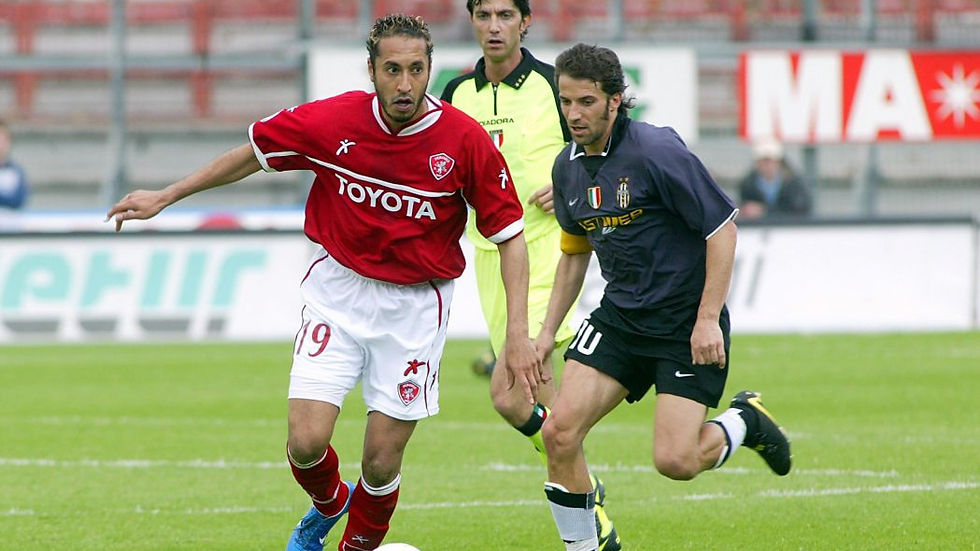
Saadi had previously trained with the Lazio youth team whilst Paul Gascoigne was playing for the side in the mid-1990s, but his short stint in Rome came to nothing. Later Saadi’s hopes of plying his trade in Italy were raised when in 2002 the Libyan Arab Foreign Investment Company bought 5.31% shares in Juventus, worth a value of around €17 million, and Saadi joined the club's board. However, seemingly any potential that Saadi could use his family’s influence to play for the Old Lady of Italian football was blocked by the World Cup-winning Italian manager Marcello Lippi, who is alleged to have blocked Saadi from playing at the club, even for the reserves. However, in spite of these setbacks, and more fundamentally his limited footballing ability, in 2003 Saadi’s made the eye-catching transfer to Serie A side Perugia.

Whilst the Italian league was past its true heyday of the 1990s, it was still one of the top leagues in the world and played host to iconic players like Kaka, Paolo Maldini, Alessandro Del Piero and Francesco Totti. Given this, Saadi’s desire to play in Serie A is easily understandable. However, the fact that he was able to able to join a team playing at a level far beyond his ability needs unpicking. Part of the picture can be understood by the fact that Italian football in the early 2000s was marred by entrenched corruption, a fact which came to the fore in 2006 when the Calciopoli scandal broke, which exposed widespread match-fixing and abuses of power by the top clubs and league officials. In this context, the wealth and influence possessed by Saadi would allow him to open many doors in the murky underworld of Italian football.

However, geopolitics were also fundamental. For the majority of the 20th century Libya and Italy had fractious relations, with Italy having colonised Libya from 1911-1947 and Gaddafi having expropriated all Italian-owned assets and expelled the 12,000 strong Italian community in Libya quickly after taking power in 1969. However, just at the time when Saadi sought to cross the Mediterranean, relations between the two countries were changing. After years of being ostracised as an international pariah, Colonel Gaddafi took advantage of the geopolitical shifts following 9/11 to improve relations with the West, which viewed strengthened ties with Gaddafi as advancing their interests regarding counterterrorism and WMD disarmament.

For Gaddafi, closer relations with Italy contributed to his aims of accessing Western markets (particularly for oil exports), attracting European investment to accelerate Libya’s development and enhancing his legitimacy globally. Equally, Italy benefitted from closer relations by enhancing its geo-strategic influence in North Africa, developing initiatives to control illegal immigration and securing access to Libya’s oil and gas supplies.

It was with these components in the background that Saadi joined Perugia, with the fact that it was a relatively small club with an eccentric owner seemingly being the key as to why it was the Umbrian side which signed Saadi. In 2003 Perugia was owned by the Italian entrepreneur Luciano Gaucci, an individual who was not afraid of making dramatic decisions or fetching headlines. For example, Gaucci terminated South Korean footballer Ahn Jung-Hwan's contract at the club simply because he scored the golden goal which eliminated Italy from the 2002 World Cup, whilst in the same summer he signed Saadi, Gaucci unsuccessfully sought to sign a female player for the Perugia mens side. Gaucci was exactly the kind of character which would see bringing Saadi to Italy as an opportunity rather than the farce it was in reality.

Overall Saadi spent two seasons at Perugia, the first of which was spent in Serie A and the second of which was spent in Serie B after the club’s relegation. Despite employing Diego Maradona as his technical consultant and Canadian sprinter Ben Johnson as his personal trainer, Saadi struggled for match time during his time in Umbria. Initially there was a furore over Saadi having to denounce his shares in Juventus prior to being able to apear for Perugia, then in October 2003 Saadi tested positive for Nandrolone and was slapped with a 3-month suspension. Voicing what was all but unanimously observed by Italian football observers, a journalist for La Repubblica commented on Saadi’s use of a performance enhancing steroid that ‘even at twice his current speed he would still be twice as slow as slow itself’.

However, in May 2004 Saadi finally made his Serie A debut. Perugia were leading 1-0 against a 10-man Juventus side when Saadi was subbed on in the 75th minute for the injured striker Jay Bothroyd and whilst Saadi only touched the ball twice, Perugia held on for a crucial win against the Italian giants. The decision to bring Saadi on in a key game at a crucial point of the season may well have been down to the lack of alternative forward options following Bothroyd’s injury and the fact that there was just 15 minutes left against an opponent with 10-men. If the speculation around an appearance clause being included in Saadi’s contract were true, manager Serse Cosmi may well have considered this to be the least risky time to play Saadi.
Whatever the case, Saadi’s teammates were pleased that the Libyan finally made his first appearance. There was a club custom that once a player made his debut he would take all his team mates out for a meal, but Saadi went a few steps further by buying each of his team mates a Mercedes A-Class. This was just one of the countless stories regarding Saadi’s lavish lifestyle during his time in Italy, such as the time he reportedly depleted a hotel’s milk supply by ordering enough for his wife to bathe in.

Saadi didn’t play a minute of the 2004-05 campaign, at the end of which Perugia went bankrupt and were relegated to Serie C. He signed for Champions League qualifiers Udinese on a 1-year contract for the 2005-06 season, in which he made one appearance, being subbed on in the 80th minute in a league match against Cagliari in which his side were already 2-0 up. Saadi started the 2006-07 season clubless but joined Sampdoria on a six-month contract in January 2007, however he would finish the season without having made a single appearance. This would prove to be the final stop on Saadi’s bizarre Italian escapade, totting up a total of around 25 minutes of play time over his four years in Italy.
It might be assumed that Saadi’s venture in Italy put a pause on the violence which accompanied his football career in Libya, but Saadi's dark streak persisted. Reda Al Tawarghi, one of Saadi’s former teammates at Al-Ahly Tripoli, accompanied Saadi and his entourage when he moved to Italy and enjoyed the luxurious lifestyle of living alongside a Gaddafi abroad. However, when Tawarghi left Saadi infuriated at having rejected his sexual advances, he was put on trial in Libya on trumped-up charges of stealing money from Saadi and imprisoned for two and a half years. Following Colonel Gaddafi’s fall in 2011, Tawarghi spoke to the media and quoted the judge as saying that ‘if Saadi says you have done wrong, then you must go to prison.’ Clearly even amidst the glamour of European football, the malevolent basis whic underpinned Saadi’s authority persisted.
Full-time for Saadi

After finishing his football career in Italy, Saadi went on to experiment with a number of new ventures, including a failed attempt at setting up a semi-autonomous commercial zone in Libya styled on Hong Kong, as well as investing $100 million in an American production company called Natural Selection in an attempt to break into Hollywood. However, as the political uprisings sweeping the Arab world began in Libya, Saadi returned home to support his embattled father, commanding an elite special force brigade during the Libyan civil war. A former soldier alleged that Saadi personally ordered soldiers to shoot unarmed protestors in Benghazi when visiting the city’s army barracks, a grim mirroring of the 1996 Libyan Cup Final. A number of Saadi’s siblings were involved in similar crackdowns, with three of his brothers being killed during the regime’s fall.

Despite numerous failed attempts at leading negotiations on behalf of loyalist forces, Saadi eventually defied a United Nations Security Council imposed travel ban and fled south to Niger. Whilst Saadi was initially granted asylum in the country, his presence in Niger led to public controversy following revelations around the lavish life he was living in the affluent neighbourhoods of Niamey, his repeated endeavours at intervening in Libyan politics and his failed attempt at fleeing to Mexico. This led the Nigerien government to give in to anti-Gaddafi figureheads in Libya and in March 2014 Saadi was extradited to Libya, soon after which a video was released of Saadi being beaten at the al-Habda prison in Tripoli.

For the final time in this story, football would again play a key role, as in May 2015 Saadi was formally charged with the unlawful imprisonment and murder of former player and coach Al-Ittihad Tripoli, Bashir al-Rayani. Al-Rayani initially had a close relationship with Saadi during the dictator’s son’s playing days and benefitted from Saadi’s patronage. However, as he became disillusioned with the corruption orchestrated by Saadi, he became an outspoken critic of Saadi’s influence on Libyan football. Inevitably this put a target on al-Rayani’s back and in March 2005 Al-Rayani’s dead body was found on a beach in Tripoli near a resort owned by Saadi. Saadi was initially convicted of Al-Rayani’s murder in 2015 but in 2018 he was acquitted and convicted of lesser charges. On his release from custody in 2021, Saadi left for Turkey. Following years of legal challenges by al-Rayani’s family, in 2024 the Libyan Supreme Court overturned Saadi’s 2018 acquittal and ordered a retrial, but to this day he is assumed to be in hiding in Turkey, whose government has declined to cooperate with inquiries regarding Saadi’s whereabouts by Interpol and the UN.
Libyan politics since Gaddafi’s fall can be categorised as fraught with instability and violence amongst rival governments, tribal militias and jihadist militants, all of which has impeded the holding of free elections and the establishment of stable governments. This volatile environment has led some in Libya to hark back to the period of Gaddafi’s rule as one of relative stability. Whilst it is the playboy lifestyle and exploits in Italian football which first grab your attention when looking at Saadi Gaddafi’s story, understanding the deep corruption, violence and authoritarian grasp with which he dominated football, much as his father dominated the country, is a stark reminder of the deep ills which accompanied Gaddafi’s rule in Libya.


Comments