From Doha to Buenos Aires: A Short History of Alternative World Cup Art
- Jack Curson
- Jan 5, 2023
- 11 min read

Updated: Jun 10, 2023
Jack Curson

From a footballing perspective, the 2022 FIFA World Cup had everything. Shock victories for underdogs in the group stages; a range of tight and feisty knockout clashes; and an all-time great final in which Lionel Messi secured both his crowning glory and, arguably, his place at the pinnacle of footballing history. However, inevitably, the host nation Qatar received widespread criticism in the run up, during and in the aftermath of the tournament. Extreme corruption in their bid for hosting rights, horrific conditions for the workers building the vast infrastructure required to host the World Cup and the endemic violation of human rights for LGBTQ+ people by the Qatari state have been the dominant themes of these critiques.
However, despite such negative press, the 2022 World Cup is an opaque attempt at sports washing, with the Qatari’s regime hoping that the overall impact of a successful World Cup would outweigh the criticisms which have been highlighted in the discourse surrounding the tournament. Whilst Qatari officials, along with the country’s array of paid-up ambassadors, offered reductionist claims promoting the separation between football and politics, a brief look back at the tournament’s history emphasises the fundamental intertwining of the World Cup and politics. From Mussolini’s manipulation of Italy’s hosting of the 1934 World Cup to promote fascism to the Football War between Honduras and El Salvador, which was sparked following the latter’s victory in the final qualification stage for the 1970 World Cup, politics forms an integral foundation of the broader tapestry surrounding World Cup history.
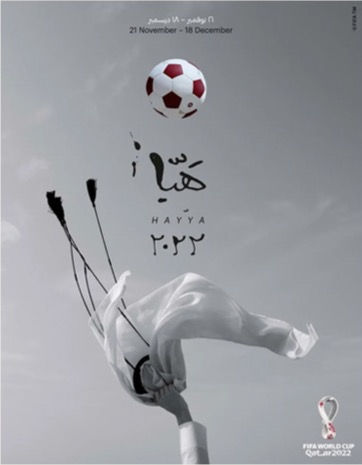
One aspect of this history I want to reflect on in more detail is the utilisation of art as a means of political contestation surrounding the World Cup. Whether it be songs, logos, mascots or posters, art forms an important part of the imagery and culture surrounding the World Cup. From Italia 90’s iconic poster and logo to K’naan’s hit song Wavin’ Flag in the run up to the 2010 World Cup in South Africa, art in its various forms compose an integral part of the legacy of numerous historic World Cups. Much of this art is made up of official marketing for the tournament itself, or independent artists profiteering from the event. However, a number of artists have utilised their art forms to criticise World Cup hosts for a variety of grievances. In this article, I will highlight some notable examples of alternative World Cup art which has been created to critique various hosts of football’s preeminent international competition. I also explore how their various contexts and complaints have informed the critical art that has been produced.
Qatar 2022
As previously mentioned, Qatar has drawn significant international criticism for its corrupt attainment of hosting rights for the event; the abysmal conditions endured by the workers taking on the monumental task of constructing World Cup infrastructure essentially from
scratch; and for its violation of the human rights of the country’s LGBTQ+ community. Such criticism has come from journalists and politicians alike, but a number of artists have also expressed their opposition to the Qatari government and the companies which, through their choice to choose profit-making over principled-opposition, are presented as complicit in the unlawfulness, discrimination and wilful indifference of the Qatari state.
Two internationally renowned artists have produced provocative works which highlight the violation of workers rights throughout the building of the Gulf state's World Cup infrastructure. Andrei Molodkin is a Russian conceptual artist who has sculpted a model
World Cup trophy entitled The Shame Cup, which was put on display at a Kennington art

gallery on December 18th, to coincide with the World Cup’s conclusion. As part of the installation, the sculpture gradually fills up with crude oil which was directly sourced from Qatari oil fields, representing what the artist describes as the ‘crude truth’ regarding corruption in Fifa. Molodkin has priced the piece at $150 million, mirroring the amount which it has been alleged FIFA bosses have received over the last quarter of a century, with all proceeds going towards a compensation programme for abused migrant workers. In reference to the deaths of migrant workers, Molodkin stated that ‘FIFA bosses knew about the human rights of workers in Qatar, for them oil money is more important than blood.”
Similarly, Danish artist Jens Galschiøt has constructed a necklace made up of 6,500 minuscule skulls to symbolise Amnesty International’s estimate of the number of migrant workers who died whilst working on Qatar’s World Cup infrastructure. Galschiøt claimed that the piece was made ‘in order to emphasise the incredible human costs’ of the World Cup hosted in a country which, 'doesn’t treat human life with basic universal fairness’. Galschiøt has also made a number of skull bracelets and encouraged individuals to share photos of his jewellery alongside the hashtag #QATAR6500 during the tournament as a means of raising the awareness of human rights abuses. Thus, through physical exhibitions and online sharing, both Molodkin and Galschiøt are examples of acclaimed global art figures who have utilised their significant artistic skill and international platforms to highlight the human rights violations which are fundamentally intertwined with the 2022 World Cup.

In contrast to these physical pieces by acclaimed artists, online creators have utilised digital forms to target the global corporations which have profited from the World Cup in Qatar. These creators utilised subvertising, that is the subversion of advertisements through parodying the logos and images created by corporations in their marketing strategies, to highlight the way in which a range of corporations have benefited from the Qatari World Cup, and consequently the human right abuses inflicted upon migrant workers.

From presenting the McDonalds Golden Arches as being made of whips to the iconic Adidas Stripes as grave stones, the subvertisements of major World Cup sponsors transform the mass-produced and mass-circulated images that are so common to Western consumers to striking effect. With mock-ups of the various logos of famous car companies, sporting brands, drink manufacturers and beyond, the subvertisements provide a clear condemnation of the true immorality of ostensibly unsullied corporations. Alongside Molodkin and Galschiøt constructions, these various art works emphasise the political and economic egoism which are at the core of many criticisms of the Qatari World Cup.


Russia 2018

The official poster for Russia 2018 paid homage to the country’s footballing heritage and its Constructivism movement of the early-20th century. Lev Yashin, the first Soviet/Russian national to win the Ballon d’Or (and still the only goalkeeper to win the pre-eminent annual football award), is depicted holding a football imprinted with Russia’s immense land mass, all upon a bright, geometric background which is characteristic of Russian Constructivism. Whilst the poster is an eye-catching retro piece which resembles some of the early World Cup posters, Ukrainian artist Andriy Yermolenko’s alternative World Cup posters outstrip Igor Gurovich’s official poster in their radicalism and, certainly, their prescience.
Given the major military campaigns and extensive international fallout following Putin’s invasion of Ukraine in 2022, it is easy to forget that Russia’s irredentism in the Ukraine dates back to 2014. It was in that year that Russia annexed Crimea and initiated support for pro-Russian separatists in Ukraine’s Donbas region. Whilst Putin’s actions in 2014 were met with a meaningful international kickback, notably its suspension from the G8, the response dwarfs in comparison to the far-reaching political and economic sanctions incurred following Russia’s invasion in 2022. However, in between Putin’s destructive expansionist ventures in Ukraine, Russia staged the World Cup in 2018. England, Iceland and Australia staged a diplomatic boycott of the tournament as a response to the use of the nerve agent Novichok by Russian agents to poison former Russian spy Sergei Skripal and his daughter Yulia in Salisbury. However, calls for a broader sporting boycott from the then Ukrainian President Petro Poroshenko failed to materialise.

Another figure who called for sporting boycotts from a greater number of countries, essentially meaning more extended and broadened boycotts than the relatively limited actions that materialised, was the Ukrainian artist Andriy Yermolenko. Inspired by the Ukrainian filmmaker and political prisoner Oleg Sentsov, who went on hunger strike in the run-up to the World Cup to demand the release of all Ukrainian political prisoners, Yermolenko created a series of alternative posters for the World Cup which aimed to put a spotlight on Russian human rights abuses. Characterised by a red and black colour scheme throughout, Yermolenko’s posters highlight Russia’s depravity and repression both at home and abroad. With references to Russia’s shooting down of Malaysia Airlines Flight 17, its bombing of civilians in Syria and the Salisbury poisonings, Yermolenko’s posters effectively highlighted Russia’s brutal policies, just as it sought to whitewash its image through its hosting of the World Cup.

Yermolenko declared that he wouldn’t watch the World Cup and advised people against it, as it was hosted by a country that ‘has shown itself as a terrorist who does not adhere to any international doctrines’, leaving the tournament ‘smeared with blood’. Sentsov’s hunger strike would last for 145 days until he stopped his protest as a consequence of serious health concerns and the threat of force feeding. He was later released in a prisoner swap between Russia and Ukraine in 2019. Whilst Putin’s most recent brutal actions in Ukraine have likely dissipated much of the soft power gains that Russia had extracted from its World Cup sports washing, Yermolenko’s posters represent an attempt to counter Putin’s sport washing in real time. Whilst his calls for a comprehensive boycott may have fallen on death ears, his poster’s online exposure raised awareness of Russian human rights violations at the time. Today, they represent a bleak and prescient unheeded warning, given Russia’s subsequent barbarity in Ukraine.


Brazil 2014
Brazil’s hosting of the World Cup in 2014 provides arguably a more interesting case when exploring alternative World Cup art. Whereas Russia and Qatar are authoritarian, human-rights abusing states, Brazil is a democracy which at the time of the World Cup had not yet been subjected to the destabilising and polarising influence of the now ex-President Jair Bolsonaro. However, the World Cup was taking place in the context of a host of unravelling political corruption scandals, with the Federal Police’s Operation Car Wash investigating a host of national and state politicians. Whilst this backdrop was represented in many of the various criticisms put forward against Brazil’s hosting of the tournament, there was a broader contention against the Brazilian government’s priorities, given the poverty existing in the country and the underfunding of public services, particularly in the aftermath of the 2008 financial crisis.
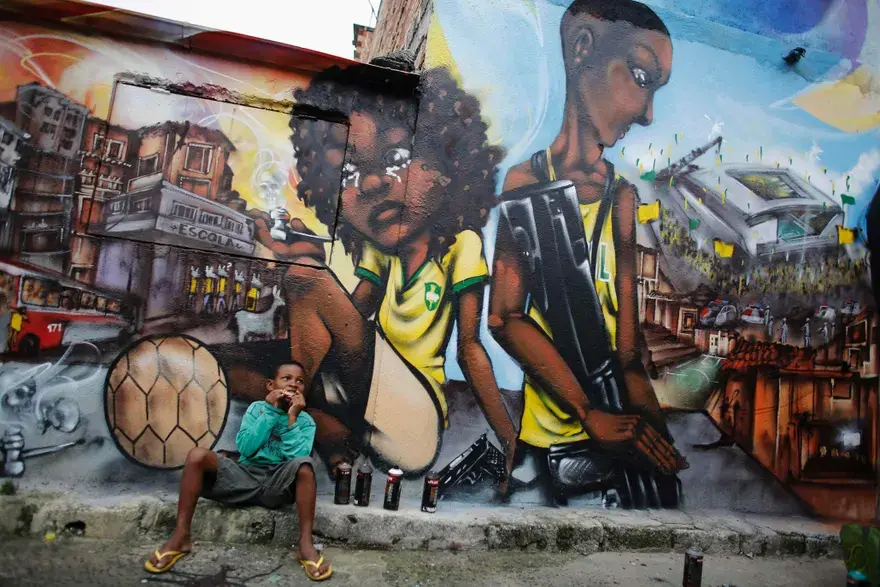
Whilst opposition to the World Cup in the country manifested itself in public protests and political debates, again, art was a major form in which people expressed discontent with their country’s hosting of the World Cup. Interestingly, the dominant form utilised by artists was urban art, with murals being plastered across Brazil’s towns and cities, from brick walls to wooden gates. In many ways, this reflects the grievances at hand and the constituencies who held them. As aforementioned, Qatar and Russia provoked responses from internationally renowned artists and individuals utilising online platforms to spread their critical art pieces around the globe. In contrast, in Brazil it was urban art, an art form which is

fundamentally more localised and public, that was dominant. Equally, just as the complaints against Qatar and Russia concerned human rights violations and international crimes, the qualms with the Brazilian government was rooted in popular discontent with national priorities, in particular allocations of federal funding and national inequality. Whilst some images of the murals garnered attention online and were circulated widely on social media, the creation of urban art in public areas across Brazil represents a popular and geographically limited form of art which is emblematic of the grievances held within Brazil. Whereas the use of digital subvertising of corporations involved in the Qatar World Cup is indicative of a fundamentally global phenomenon, the geographically specific and limited nature of urban art in Brazil is reflective of an issue which is largely experienced and criticised by Brazilians as opposed to the international community. Whilst the underfunding of services and societal inequality may not be as egregious or visceral for international audiences as issues like human rights violations and international crimes, they’re serious and consequential problems which rightfully drew significant criticism amongst the Brazilian population.

The various murals varied in their styles, symbols and messages. Some directly criticised FIFA and others the Brazilian government, whilst many focused on drawing attention to the impoverishment and suffering of Brazil’s poorest citizens, suffering which is all the more cruel given the over $10 billion spent on the World Cup. Some artists also chose to mock Fuleco, the yellow armadillo which was the official mascot of the 2014 World Cup, with one piece depicting Fuleco holding a rifle alongside the message 'Queremos educaçāo não repressão!' ('We want education not repression!'). From malnourished children with nothing but a football to eat, to a ginormous, mechanised football mowing down people’s homes, Brazilian urban artists created a range of powerful images which convey the darker realities of contemporary life in arguably the World Cup’s most iconic participant.


Argentina 1978
Finally, I jump back further in time to the 1978 World Cup, which was hosted by the competition’s most recent winners, Argentina. In 1978, Argentina was governed by a military junta which had seized power in a coup two years previously. The Junta, led by Lieutenant General Jorge Rafael Videla’s, was a brutal regime which committed systematic human rights violations against the Argentinian people. Termed the ‘Dirty War,’ the military junta engaged in state terrorism and routinely killed or ‘disappeared’ political opponents, with estimated casualties ranging between 9,000 & 30,000 people. Spurred on by Mario Kempes’ outstanding performances, Argentina won the tournament, defeating the Netherlands 3-1 in the final in Buenos Aires. However, serious and substantial allegations of match fixing persist even today, particularly surrounding favourable refereeing decisions and improbable score lines benefiting the South American hosts. Certainly, given the junta’s various political interests in a successful tournament, including legitimising its leadership and instilling jubilation in a systematically oppressed population, some form of political interference from the corrupt Argentinian leadership is wholly intelligible.

Given the horrific human rights record of the military junta, opposition to Argentina’s hosting of the 1978 tournament was rife globally. One way this opposition manifested itself was through an international boycott campaign, which was initiated in Paris following the creation of the Committee for the Boycott of the World Cup in Argentina (COBA). Over 200 COBA chapters were established in France and similar campaigns were organised across Europe, including in West Germany, Italy and the Netherlands, and beyond, including in the US, Mexico and Israel. Despite public discussion over participation in the tournament being held in many countries, including the eventual runners-up the Netherlands, no country chose to boycott the event. Whilst their ultimate goal was not achieved, the various campaigns were successful in developing a transnational solidarity movement which raised awareness of the Argentinian regime’s appalling human rights record. Additionally, other campaigns focused on raising awareness rather than specifically calling for a boycott, including Amnesty International’s call for all those attending to investigate human right abuses in the country and spread their findings.


These various campaigns utilised a range of political tactics, including organising protests, making documentaries and holding press conferences. However, arguably the most striking and enduring messages from the various campaigns came in the form of art. COBA’s classic poster, presented above, subverts the tournament’s official logo by putting it's abstract depiction of hands holding a football at the core of a row of barbed wire fences, referencing the regime's use of concentration camps against its political opponents. Just as urban artists in Brazil mocked the mascot of the 2014 World Cup in their murals, COBA artists chose to manipulate the logo for the 1978 World Cup to emphasise the divergence between the sanitised official imagery and the appalling social and political issues which they sought to emphasise in their art. Similarly, Amnesty International’s poster of a football made out of barbed wire highlights the use of concentration camps during the Dirty War. Clearly, art was a key mode by which actors who were critical of Argentina’s hosting of the tournament conveyed their discontent.


Whilst 1978 is remembered as the first time Argentina won the World Cup, the 2022 World Cup represented the crowning achievement of arguably Argentina, and the world’s, greatest ever footballer. However, just as the mesmerising footballing brilliance showcased in World Cups past and present must be remembered, so too must the social and political injustices evident in many of the previous host nations, along with their deleterious consequences. Only by appreciating both the sporting excellence and the broader socio-political contexts upon which major tournaments have taken place, can a comprehensive understanding of international football be achieved. Whilst Qatar will rightfully be remembered as the World Cup where Messi, in many people’s eyes, secured his place at the apex of football history, we must also remember the violation of human rights which occurred in Qatar and advocate for the various campaigns calling for recompense for victims. Whether it be Argentina ’78 of Qatar ’22, politics and football, despite what detractors may say, are perennially intertwined.
For more of...
- The Qatari World Cup subvertisements:
- Andriy Yermolenko's posters:
- Brazilian World Cup urban art:
- The 1978 anti-Junta images:


Comments