From Proto-communist Experiment to Britain’s Beverley Hills: The Demise of St George’s Hill
- Jack Curson
- May 10, 2024
- 11 min read

Updated: May 11, 2024
Jack Curson

At first glance, the private gated community of St George’s Hill would appear to be nothing more than a soulless stomping ground for the filthy rich. One of the most exclusive neighbourhoods in the whiole of Britain, St George’s Hill, nestled in leafy home counties Surrey, is the epitome of elite living. The 964-acre gated community boasts a golf club, tennis club and over 400 luxury houses, which home some of the wealthiest celebrities, sportspeople and businesspeople in Britain, and indeed the world. With an estimated total property value of over £3 billion and a number of listed buildings worth tens of millions, it's easy to see why St George’s Hill has garnered itself the title ‘Britain’s Beverley Hills’.
However, beyond the star-studded list of St George’s Hills’s rich and famous residents and its grandiose buildings, lies a much more intriguing story. Over 300 years before it became the destination of choice for pop superstars and Russian oligarchs, St George’s Hill was the site of an historic act of defiance by a small group of English commoners. During a period of unprecedented change in Britain, a rag-tag group of landless local people chose St George’s Hill as the location at which they would retake their rights and create a new kind of community, one-based on true individual liberty and communal solidarity. Led by local cowherder-cum-pamphleteer Gerrard Winstanley, through the farming of the common land of St George’s Hill, the group known as the Diggers sought to contest the centuries-long dominance of the country’s elite and regenerate the lives of the common people.
There’s a profound irony that St George’s Hill, once a site of revolutionary action and staunch defiance to authority, is now a private gated community for the wealthiest, many of who's homes are in fact owned by companies registered offshore in tax havens. To add to the irony, today the residents’ association of St George’s Hill mandates that every house must have at least one acre of land attached to it. Clearly, the principles of the Diggers are being played out today, just exclusively among the community’s multi-millionaire residents, as opposed to the broader population, in a kind of socialism for the rich, capitalism for the poor. This is the story of the sad decline of St George’s Hill.
A Dead King and New Beginnings
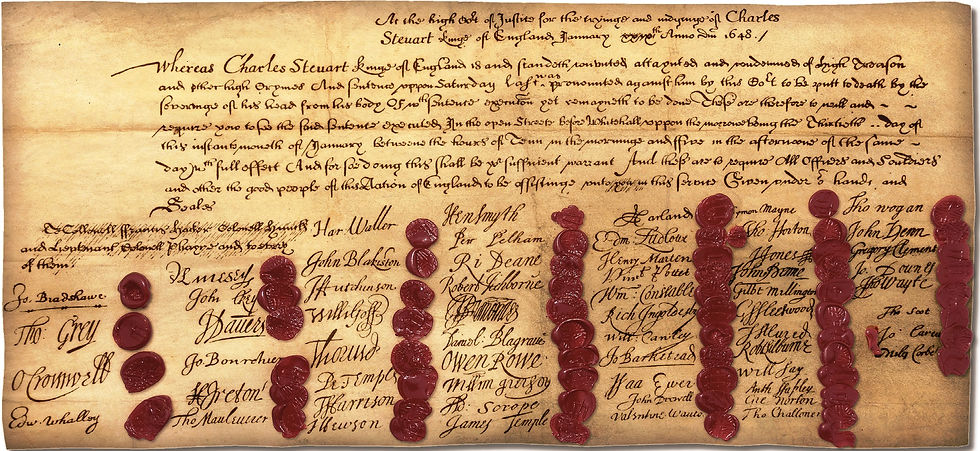
In January 1649, English parliamentarians made the monumental decision to execute Charles I and bring down the Stuart monarchy, following almost a decade of civil war between the royalists and parliamentarians. Along with the bloodshed and violence which spread across the British Isles like wildfire, the 1640s saw Britain plunged into a turbulent period of social, political and religious tumult. The erosion of the Church’s dominance and the consequential rise in religious freedom led to a number of radical, non-conformist religious denominations springing up across Britain. Moreover, the regicide brought to an end, in one fell swoop, a centuries-long institution of monarchic governance based on a perceived divine right to rule, prompting novel innovations in the country’s governing structures. At the start of 1649, added to this volatile mixture was a nation-wide mutiny amongst the unpaid soldiers of the parliamentary army, with workers in key industries, from Somerset farmers to Derbyshire colliers, rising in their support. Britain was in a storm of unrest.
In this chaotic climate of radicalism, innovation, violence and insecurity, St George’s Hill in Surrey would be the site of a novel experiment, one which was small in scale but revolutionary in its convictions. Driven by a strongly-held antipathy against the ever-expanding reach of political elites and a principled belief in communal solidarity and individual liberty, a small group of English commoners attempted to carve out their own island of freedom within the divided British isles.
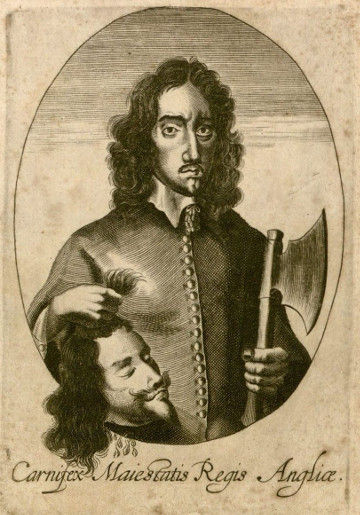
The Diggers were unofficially led by Gerrard Winstanley, who by the late 1640s was working as a cowherd in Surrey whilst simultaneously being a prolific pamphleteer, writing tracts which initially focused on religion but quickly went on to focus on his radical political ideas. Winstanley’s convictions, whilst in-part idealistic, went beyond much of what is espoused by today’s ‘progressive’ politicians, including support for the provision of universal education, the annual re-election of officials, the abolition of standing armies and an end to foreign wars of aggression. In a pamphlet of January 1649 entitled The New Law of Righteousness, Winstanley condemned the seizure of English land by the ruling classes through violence and repressive legislation and called for the poor to rise up, non-violently, to take back their land. In just a few months, Winstanley and his band of comrades would put this particular vein of his political thought into practice.

Winstanley saw the execution of Charles I as a defining moment, an unprecedented opportunity to strip back the power of the landowning elite, who he perceived as having enslaved the common people since the Norman invasion of 1066. Following the Battle of Hastings and the consequential seizure of control over England by the Normans, all land was declared to be the property of the Crown. As such, it was the king’s property to divide and hand out as patronage to his followers at will. This led to the formation of a landed elite made-up of Norman barons, who’s land and privileges were protected and passed down through their lineages. Vast swathes of common land, which had previously been freely accessible for the masses and utilised by common people to graze their livestock and gather firewood, was now enclosed and seized for private use. Along with this historical dilution of the common people’s land rights, Charles' beheading had led to the freeing of the middle classes from the protectionist constraints which had been imposed on them by the monarchy, allowing them to rapidly enclose large parts of the remaining common land upon which the poor depended.

In April 1649, St George’s Hill was made up of an assortment of common land and Crown land, the ownership of which had come into question following Charles’ beheading. Whilst the occupation of St George’s Hill began with just a few individuals, within days their numbers had swelled to almost 30 people, made up largely of landless peasants who’d fought for the parliamentarian cause during the civil war. Having occupied the land, they constructed themselves humble houses to live in, brought in farm animals to graze the land and began to plant a variety of crops. The produce they yielded would then be distributed, without charge, to any individual who chose to join them in their work. In this way, the Diggers were putting Winstanley’s convictions of eradicating social hierarchy, economic inequality and land expropriation into action through the creation of a radical agrarian proto-communist settlement.
The Establishment Fights Back

Unfortunately, but wholly expectedly, the Diggers were met with fierce and resolute hostility. Mobs of vigilantes, co-opted and co-ordinated by local clergy and the Lord of the Manor, tore down and set alight the Digger’s makeshift homes, smashed their tools and physically attacked them, violence which the Diggers resolutely refused to respond to in-kind. Unfortunately, this theme of normal people misguidedly targeting their frustrations towards the very individuals with whom they share so much of their economic, political and social disempowerment, as opposed to those with the authority and agency to actually change their lot, is one that is all too common throughout history and, indeed, is easily recognisable today.
The Diggers’ radical experiment on St George’s Hill also drew national attention. 3 weeks after the occupation began, Winstanley was summoned by Thomas Fairfax, the Commander-in-Chief of the army and a key parliamentarian general during the Civil War. Naturally, Fairfax was deeply fearful of the consequences of Winstanley’s ideas spreading, as well as the occupation tactics of the Diggers being replicated elsewhere. These concerns were proven well-founded, as soon after the Diggers’ occupation of St George’s Hill began, other groups calling themselves Diggers had sprung up and seized other parches of land in counties across England.

On meeting Fairfax, Winstanley refused to remove his hat, as would have been common practice on meeting such an esteemed member of the nobility, based on his conviction that no man could rightfully be considered to be worthier than another. Clearly Fairfax was unsuccessful in his attempts to pacify the Diggers’ spiritual leader, as soon after his meeting with the esteemed general, Winstanley sent Fairfax a declaration of independence in which he declared, ‘while we keep within the bounds of our Commons… your laws then shall not reach us, unless you will oppress or shed the blood of the innocent’.
However, in August 1649, just a few months after the occupation had begun, the group were driven off St George’s Hill. The Diggers were convicted on trumped up charges of being ‘sexually liberal Ranters’, in a court case in which they were forbidden from speaking in their own defence. With the threat of the army evicting them by force looming over them, the short-lived experiment on St George’s Hill was brought to an end. The group moved on to another patch of land in Surrey, but under continued pressure and provocations from local landowners, the group eventually disbanded in April 1650, almost exactly a year after the occupation of St George’s Hill had begun.
A Different Kind of Vision

After the the Diggers’ eviction from the land, St George’s Hill went into relative obscurity for over 250 years. After being compulsorily enclosed by an Act of Parliament at the beginning of the 19th century, its ownership changed hands from the Duke of York to the Earl of Ellesmere, until in 1911 it was bought by the housing developer Walter George Tarrant. Tarrant quickly went about turning the 964-acre plot into a huge development site, building a stock of luxury homes to cater for those of London’s wealthy elite looking for a spot out in the countryside, whilst retaining easy access to the capital.
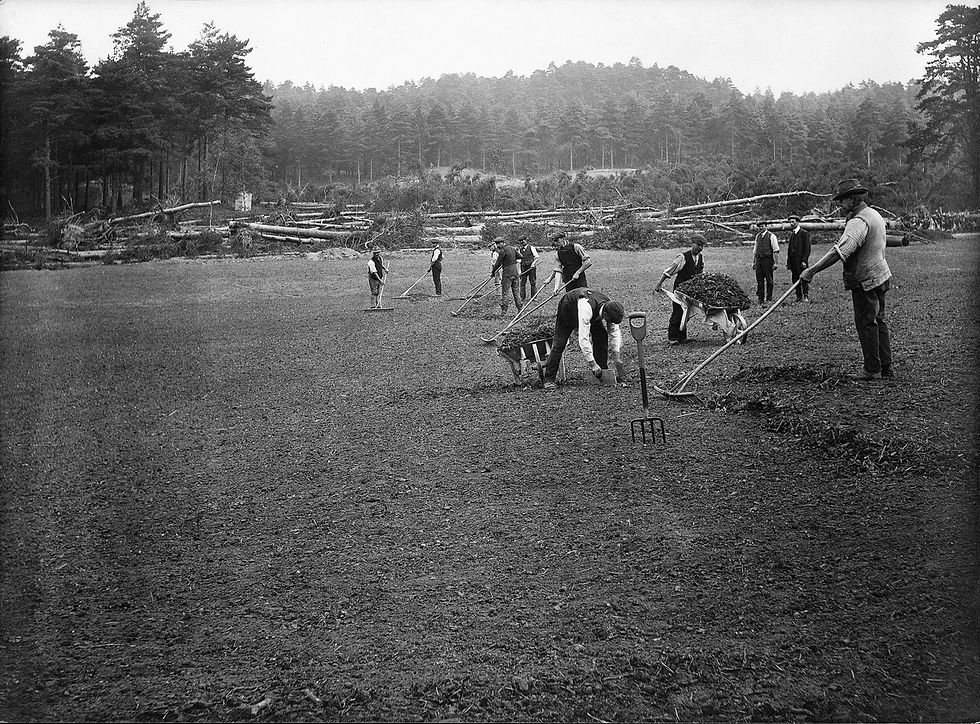
As well as building extravagant homes and a tennis club from the ground up, a vast number of pine trees and rhododendrons, which had flourished in the wilderness, were stripped down to allow for the landscaping of a significant portion of the hill into a luxury golf course. St George’s Hill Golf Club remains in business today, as an amenity for the Uber-rich residents of St George’s Hill. Indeed, the section of their website which celebrates the club’s history even includes a photo of a huge stack of logged pines trees, celebrating the deforestation inflicted on the site for the benefit of St George’s Hill’s wealthy residents.
The list of residents that have lived in St George’s Hill over the last 60 years read as a roll call of some of the biggest celebrities in England, and indeed the world, including John Lennon, Elton John, Tom Jones, John Terry, Nick Faldo and Jenson Button. Alongside pop stars and sportspeople, extremely wealthy business people and entrepreneurs have also made St George’s Hill their home, including former Dragons Den star Theo Paphitis and the richest person in Pakistan, Mian Muhammad Mansha. It is no surprise that St George’s Hill has gained the moniker, ‘Britain’s Beverley Hills’.
Dirty Money and Dirty Deeds

In stark contrast to the Diggers’ idealist vision, today the ownership of the luxury properties on St George’s Hill reveals more about the murky financial dealings of the today’s uber-rich. Whilst many homeowners are well-known as a result of their position in the public eye, a great number of the real owners of properties on St George’s Hill are shrouded in secrecy as a result of offshore jurisdictions. An investigation by Private Eye revealed that over 70 of the mansions on St George’s Hill are owned offshore in tax havens like the British Virgin Islands and Channel Islands, amounting to a total property value of around £280 million. Clearly defiance to the state remains very much alive on St George’s Hill, but in the form of egoistic tax-evasion, rather than a radical localised form of communal solidarity.
The release of the Panama Papers in 2016, which revealed the personal and financial details of a huge number of individuals who’d used Panama’s tax haven status to avoid paying their fair share of taxes, allowed for the details of some of the more opaque ownership arrangements on St George’s Hill to be revealed. For example, Squirrel’s Wood mansion is owned by a Panamanian company whose director, Dianeth M. De Ospino, appeared in the Panama Papers releases. She, along with fellow director José Eugenio Silva Ritter, work for a Panama law firm which was implicated in money laundering charges which were laid against the former president of Peru, Alejandro Toledo. Toledo was implicated in Operation Car Wash, an anti-corruption probe which revealed a transnational corruption network spanning across Latin America, and has since been extradited from the US to Peru to face charges of money laundering.

Many luxury homes on St George’s Hill have been bought-up by wealthy Russians, with one 2022 estimate suggesting that over a quarter of the properties on St George’s Hill are owned either by Russians or foreign nationals from the former Soviet states. One notable example is Russian oligarch Oleg Deripaska, who in 2001 purchase the grade II listed Hamstone House through his Edenfield Investments company, which is registered in Cyprus as a means of avoiding tax. Deripaska made his money during the sweeping privatisation of post-Soviet period and was once Russia’s wealthiest man. He has close ties to Putin and was one of the 7 Russians that faced targeted sanctions by the British government following the 2022 invasion of Ukraine.

Putin’s nefarious grasp on many Russians living abroad may well have played a part in the mysterious death of another Russian businessman with a home on St George’s Hill, Alexander Perepilichny. In 2010, soon after having left Moscow to live in a luxury home on St George’s Hill, Perepilichny handed over a collection of documents to Swiss prosecutors which detailed the involvement of Russian officials in a fraud amounting to around $230 million from the Russian treasury. Perepilichny’s new life in Britain would be short-lived, as in November 2012 he was found lying dead on the road by one of his neighbours after having gone for a jog around St George’s Hill. Russian state involvement in his death remains unproven, but the mysterious death of a whistleblower bears the hallmarks of a Putin-ordered hit, especially given Perepilichny had no previous health issues and a mysterious toxin was discovered in his stomach during an autopsy.
Down But Not Out

In The New Law of Righteousness, Winstanley posed the following question:
‘Was the Earth made to preserve a few covetous, proud men to live at ease, and for them to bag and barn up the treasures of the Earth from others, that these may beg or starve in a fruitful land, or was it made to preserve all her children?’
Whether it’s residents be pop icons, leading sportsmen, business magnates or Russian oligarchs, clearly the gated community of St George’s Hill epitomises the exact thing that Winstanley was fighting against. A plot which once was the site of radical action, now homes tax avoiders and oligarchs. A site which should hold a privileged position in the history of Britain, and indeed that of radical political action more broadly, is now out of reach for all but a fortunate few. On a land where common people used to roam and bright visions of the future were played out, now sit luxury homes protected by domineering electronic gates and ever-watching CCTV cameras.

Whilst the site of St George’s Hill might be lost, the memory of the Diggers lives on, resolutely. Winstanley’s name was carved into the Soviet’s Alexander Garden Obelisk, establishing his place as one of the most important progressive thinkers in modern history. Even more meaningfully, the Diggers’ actions on St George’s Hill continue to be remembered and re-enacted through community action in Britain today. Just one example of this is the Bolton Diggers, who have established community food gardens and a Common Wealth cafe, which is stocked with surplus food from supermarkets and bought by local customers on a pay-what-you-can basis.

On April 1st 1999, campaigners from the Land is Ours lands rights campaign group occupied land on St George’s Hill and held a rally to commemorate the 350th anniversary of the Diggers’ occupation of the hill. Whilst the reality of St George’s Hill today is a far cry from Winstanley’s vision of a better world, the message of the Diggers lives on. By linking the exploitation of the earth with the exploitation of normal people, by establishing a link between private property and capitalism with exclusion and inequality, it’s clear that the Diggers’ message remains an essential one to be held dear today.


Comments