The Holy Trinity of Reggae Cinema
- Jack Curson
- Jun 8, 2023
- 16 min read

Jack Curson

Since its origins in the late-1960s, reggae has had a monumental impact on Jamaican culture and that of its far-flung diaspora. This is not to mention its broader, cross-generational impact, with the genre having penetrated manifold national and racial boundaries to achieve global acclaim. Reggae’s greatest icons and flag-bearers are predominantly known for their musical accomplishments, and it is its iconic music which has been integral to the genre’s evolution and diffusion. However, a somewhat lesser-known and lesser-appreciated facet of reggae’s history is that of reggae cinema, something which has been influential in reggae’s dynamic rise.

One part of this rich archive of cinema comes in the form of documentaries. Some fuse live recordings and interviews to give a raw and direct presentation of reggae music. My personal favourite of this type is Wolfgang Büld’s eye-catching presentation of the 1970s British Reggae movement in Reggae in a Babylon. This fifty-minute documentary includes performances and interviews from pre-eminent British reggae groups like Aswad and Steel Pulse, but also lesser-known and even un-named reggae artists active in Britain at the time.
Other documentaries have chosen to focus on significant sub-genres, like Menelik Shabazz’s The Story of Lovers Rock, whilst more still have reflected on the lives and works of some reggae’s major figures. Given his place as the foremost icon of reggae and Rastafarianism alike, there have been a great number of documentaries focusing on Bob Marley. However, Esther Anderson’s and Gian Codoy’s Bob Marley: The Making of a Legend received particular acclaim as a result of its incorporation of an array of long-lost photographs and footage, collected by Anderson herself during her relationship with Marley during the 1970s.
The 2019 film Inna De Yard, directed by Peter Webber, also deserves an honourable mention. The movie documents a project in which a group of ageing, though formerly pioneering, reggae musicians are brought together to create an album made up of their old classics and new creations. With an accompanying soundtrack featuring reggae greats like Kiddus I, Cedric Myton, Ken Boothe and Horace Andy, Inna De Yard acts as a kind of Jamaican adaptation of the acclaimed Cuban Buena Vista Social Club ensemble.

Alongside these documentaries, there’s also a collection of films which, rather than documenting the real-world performances and lives of reggae artists, utilise reggae as a cultural focus and musical tool as part of a broader narrative. In these works, the people, music and stories integral to reggae and its history are fundamental. A plethora of films make-up the diverse catalogue of reggae cinema, however I’ve chosen to focus on just three films which make up a brilliant triad of arguably the most acclaimed and influential reggae films of all time. All released within a decade of each other, indeed a momentous decade for reggae music, and all united by a distinct realism, impressive acting performances from reggae stars and, of course, incredible soundtracks, The Harder They Come, Rockers and Babylon make up an exceptional collection of must-see reggae films.
The Father - The Harder They Come (1972)
Being both the first Jamaican-produced feature film as well as the film which is said to have brought reggae to the world, The Harder They Come, directed by Perry Henzell and starring reggae artist Jimmy Cliff, has to be considered the father of reggae cinema. The film, released in 1972 after two protracted years of production due to funding shortfalls, was an instant sensation in Jamaica. This was largely a result of its striking realism, with Henzell observing that, ‘black people seeing themselves on the screen for the first time created an unbelievable audience reaction’. The Harder They Come offers a naturalistic presentation of Jamaican life, portraying black Jamaicans living in real locations and using authentic Jamaican patois. In fact, the patois was considered to be so thick that subtitles were added to its US release, making it the first English language movie to require subtitles in the US. Whilst the movie’s release in America in 1973 was initially met with minimal fanfare, it soon became a cult hit when it was played to midnight audiences, helping to raise the profile of reggae to audiences across the US, Western Europe and beyond.
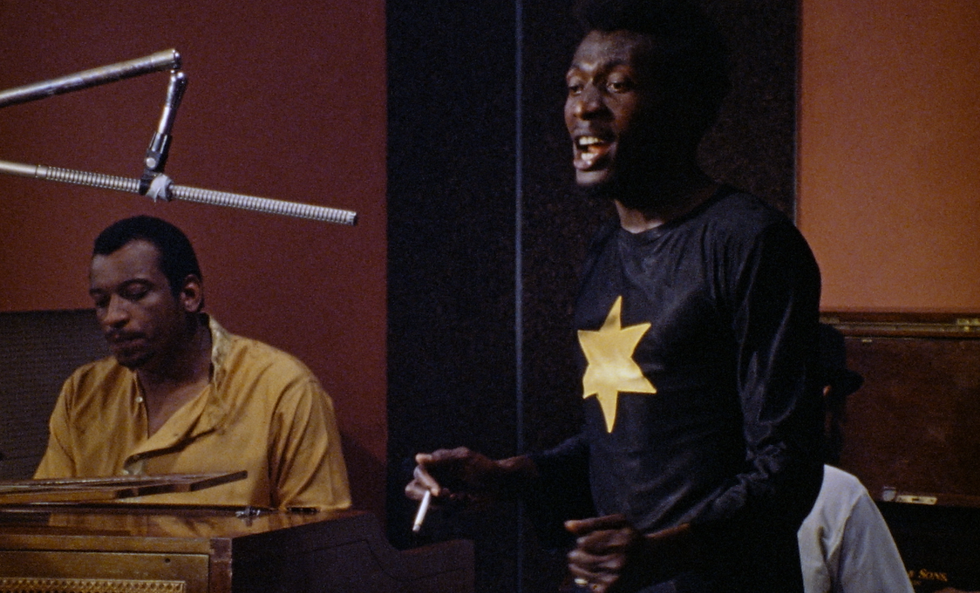
The Harder They Come follows the story of Cliff’s character Ivan, a young man who moves from the Jamaican countryside to bustling Kingston in the hope of finding work following the death of his grandmother. However, rather than finding fame and fortune, Ivan struggles to secure a job and ends up a victim of the all-too life-like corrupt record industry, when an exploitative local record mogul named Hilton gives Cliff’s character just $20 for the titular record, ‘The Harder They Come’. When circumstances push Ivan into a life of crime as a drug runner, a dramatic spiral is set in motion.
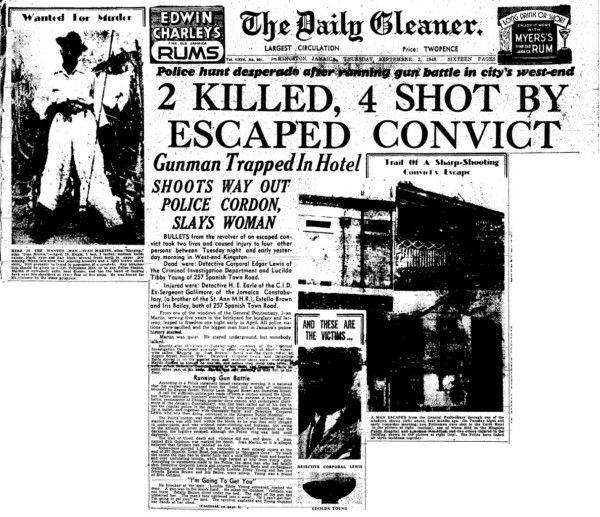
The story’s protagonist is based on a real-life Jamaican criminal who was the subject of extreme national furore during the 1940s. Like Cliff’s character, Vincent ‘Ivanhoe’ Martin turned to a life of crime after moving to Kingston from rural Jamaica during his youth. In 1948 the real-life Ivan gained the popular epiphet Rhyging, a variant of the patois term ‘raging’, after escaping prison, going on the run and committing a string of robberies, murders and attempted murders. Whilst Rhyging was the subject of a major criminal investigation and rightfully drew the ire of many, he also became a folk hero for other Jamaicans, much like the legendary outlaws Bonnie and Clyde became anti-hero’s in the eyes of many Americans during the harsh years of the Great Depression. This complex reality is reflected in the multi-faceted nature of Cliff’s character, who is presented as a warm-hearted and determined victim of a brutal society and exploitative record industry, whilst simultaneously being a manic, violent criminal.
Many of the events in The Harder They Come mirror the story of Rhyging’s crime spree. This includes the gun-toting staged photographs which Ivan sends to the press to taunt the police that were pursuing him, along with his dramatic final-stand on a strip of Jamaican coastline. However, unlike the real Rhyging, Cliff’s character tries his hand in the burgeoning reggae industry and gets involved in the more nefarious underworld of drug smuggling. In this way Cliff’s character represents both the rich cultural environment and troubled social context of post-independence Jamaica, in which a significant section of Jamaica’s disenfranchised youth turned to crime and violence, thus obtaining the popularly moniker ‘rude boys’. Rhyging has subsequently been referred to by various historians as the ‘original rude boy’, and the The Harder They Come does a brilliant job of transplanting his story into this complex post-independence social context.

The movie was co-written by an intriguing duo, Perry Henzell and Trevor Rhone. Henzell was a white Jamaican originating from a wealthy land-owning family who’d made their fortune in the sugar industry. After spending his formative years growing up on his family’s sugar estate in Caymanas near Kingston, Henzell left the island to hitchhike around Europe, after which he worked as a stagehand at the BBC. Henzell returned to Jamaica and worked as advertisement director for a number of years prior to his involvement in The Harder They Come. In contrast, Rhone was a black Jamaican who grew up as the last child of 23 in the small town of Bellas Gate in Saint Catherine Parish. Involved in the theatre from a young age, after studying drama at college, Rhone went on to work as a drama teacher and would be an important part of the renaissance of Jamaican theatre in the early 1970s. Both would go on to work on other film projects, including Henzell’s work on further installations of a trilogy focusing on Ivan’s life. However, it’s The Harder They Come for which both men are best known today.

The film’s cast was predominantly made up of people with little or no acting experience, all
of whom were selected by either Henzell or Rhone, and amongst this cast there were a number of key figures in the nascent Jamaican reggae scene. Alongside Jimmy Cliff’s captivating portrayal of Ivan, Toots and the Maytals make a cameo as they record their hit song ‘Sweet and Dandy’ just before Ivan records the titular record, Prince Buster is the DJ who first plays Ivan’s song to the acclaim of other reggae enthusiasts during the dance scene and Alton Ellis even features as Ivan’s Double. Alongside these musicians, influential Chinese-Jamaican reggae producer Leslie Kong plays the recording engineer during Ivan’s recording of ‘The Harder They Come’, whilst Ras Daniel Hartman, a key figure of the Rastafarian art movement who designed a number of well-known reggae album covers from the 1960s and 1970s, plays Ivan’s friend, Pedro.
Aside from the reggae scene, The Harder They Come was also the first big-screen opportunity for the actor who has been described in the Jamaican national newspaper The Jamaica Star as ‘Jamaica’s most renowned actor’, Carl Bradshaw. Before achieving national show biz fame, Bradshaw competed as an athlete at the 1968 Central American and Caribbean Games and later worked as a PE teacher at Excelsior High School. It was here where Yvonne Brewster, the school’s drama teacher and future successful actor and theatre director in her own right, recommended him for the movie. Bradshaw plays the head of the illicit drug smuggling ring, Jose, and this role would prove to be a springboard for his acting career. Bradshaw would go on to star in some of Rhone’s other cinema projects including the critically acclaimed Smile Orange and One Love, along with numerous other major Jamaican films like Countryman and Dancehall Queen.

The movie’s soundtrack, which was released in 1972 by Island Records and curated by Henzell, became an instant reggae classic. Indeed, the album has come to be considered not just a classic of the genre, but also an album that ranks amongst the most important of the 20th century; Rolling Stone rated it as one of the 200 greatest albums of all time and the Library of the US Congress selected it for preservation in the National Recording Registry for its integral role in fuelling reggae’s rapid rise in popularity in the US.
The heart of the album comes from the film’s star, with Cliff recording the titular track specifically for the soundtrack when the project’s name was changed from its original working title ‘Rhyging’ to The Harder They Come. The remainder of the album is a compilation of reggae singles released from 1967-72, including classics like The Slickers’ ‘Johnny Too Bad’; Toots and the Maytals’ ‘Sweet and Dandy’; and The Melodians’ ‘Rivers of Babylon’. If The Harder They Come is the father of reggae cinema, then its soundtrack is certainly the father of reggae soundtracks, a short but sweet snapshot of early reggae which features many of the genres earliest shining stars.
The Son - Rockers (1978)

Given that Francis Ford Coppola’s war epic Apocalypse Now is considered to be one of the greatest films ever made, it’s telling that it was overshadowed at the 1979 Cannes Film Festival by a classic of both reggae and Jamaican cinema alike, Rockers. Whilst the movie premiered at the San Francisco Film Festival in 1978, its screenings at one of the world’s premier international film festivals the following year caused pandemonium. In the area surrounding the movie theatres where the film was scheduled to play, fervent crowds trying to secure tickets for the 4 sold-out screenings jammed the streets and refused to leave disappointed. Thus ensued a chaotic incident involving both mounted police and riot police, a stir which was plastered on the front pages of the national newspapers in France. Not bad for a film with a relatively meagre budget of just some $500,000.
The story, which begins as a loose interpretation of Vittorio De Sica’s The Bicycle Thief before evolving into a reggae interpretation of the Robin Hood story, centres on the film’s protagonist, Horsemouth. Horsemouth is a struggling drummer living in a Kingston ghetto, who convinces his wife to lend him money so he can buy a motorcycle and sell reggae records to the various sound systems and record shops across the island. However, after his motorcycle is stolen by local gangsters, indeed gangsters for whom he works as a performer at a luxury hotel, Horsemouth and his friends hatch a plan to take back the gangsters’ storehouse-worth of stolen goods and redistribute them to the underprivileged masses in Kingston.

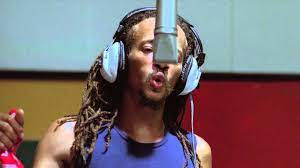
Given that the story is partly based on De Sica’s post-war neorealist classic, it is no surprise that Rockers shares the distinct realist traits which characterise The Harder They Come. Alongside the dialogue being in patois, Rockers director Theodoros Bafaloukos consciously avoided the picturesque sandy beaches, typical tropes of mainstream cinematic depictions of the Caribbean, and instead focused on communal living inside Kingston ghettos as a means of authentically reflecting the lives of ordinary Jamaicans. In fact, Bafaloukos had originally intended for the project to be a documentary rather than a feature length film, and as such the film features huge amounts of authentic characters, scenes and culture. For example, Leroy ‘Horsemouth’ Wallace is shown living with his actual wife and kids in his real-life home, whilst Kiddus I’s recording of ‘Graduation in Zion’ was organically captured during one of Bafaloukos’ visits to the iconic Harry J Studios. Given reggae revolves around an authentic retelling of the black experience in Babylon, it is unsurprising that realism is an essential characteristic which translates from the music to
the silver screen.
Bafaloukos was born on the Greek island of Andros, but it is his work in Jamaica for which he is most remembered. Bafaloukos arrived on the island as a freelance photographer for Island Records in 1975. This job, along with the friendship he quickly struck up with the acclaimed dub producer Augustus Pablo, allowed him to get access to the plethora of reggae icons who were living and working in Jamaica at the time, many of whom would become involved in Rockers.
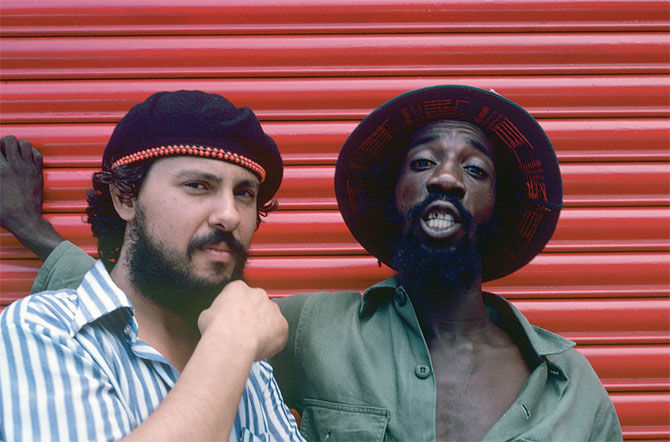
As well as being a high point for reggae, the period in which Bafaloukos arrived in Jamaica was also slap bang in the middle of a turbulent decade for Jamaica. The nation was experiencing violent political conflict between Michael Manley’s socialist leaning People’s National Party and Edward Seaga’s pro-American Jamaica Labour Party, with each party arming many of their most ardent supporters as a means of intimidation and retaining territorial control.

Extraordinarily, Bafaloukos quickly became a victim of this tempestuous environment. Just days after having been accused of being a spy whilst photographing various musicians during a visit to Bob Marley’s Kingston home, Bafaloukos was arrested in a car park by Jamaican police under the accusation that he was a CIA agent. Bafaloukos was eventually released without charge following an interrogation, however the episode proves that the Rockers director got an authentic experience of 1970s Jamaica, a Jamaica which was characterised by both extremely divisive political partisanship and incredibly rich musical innovation.
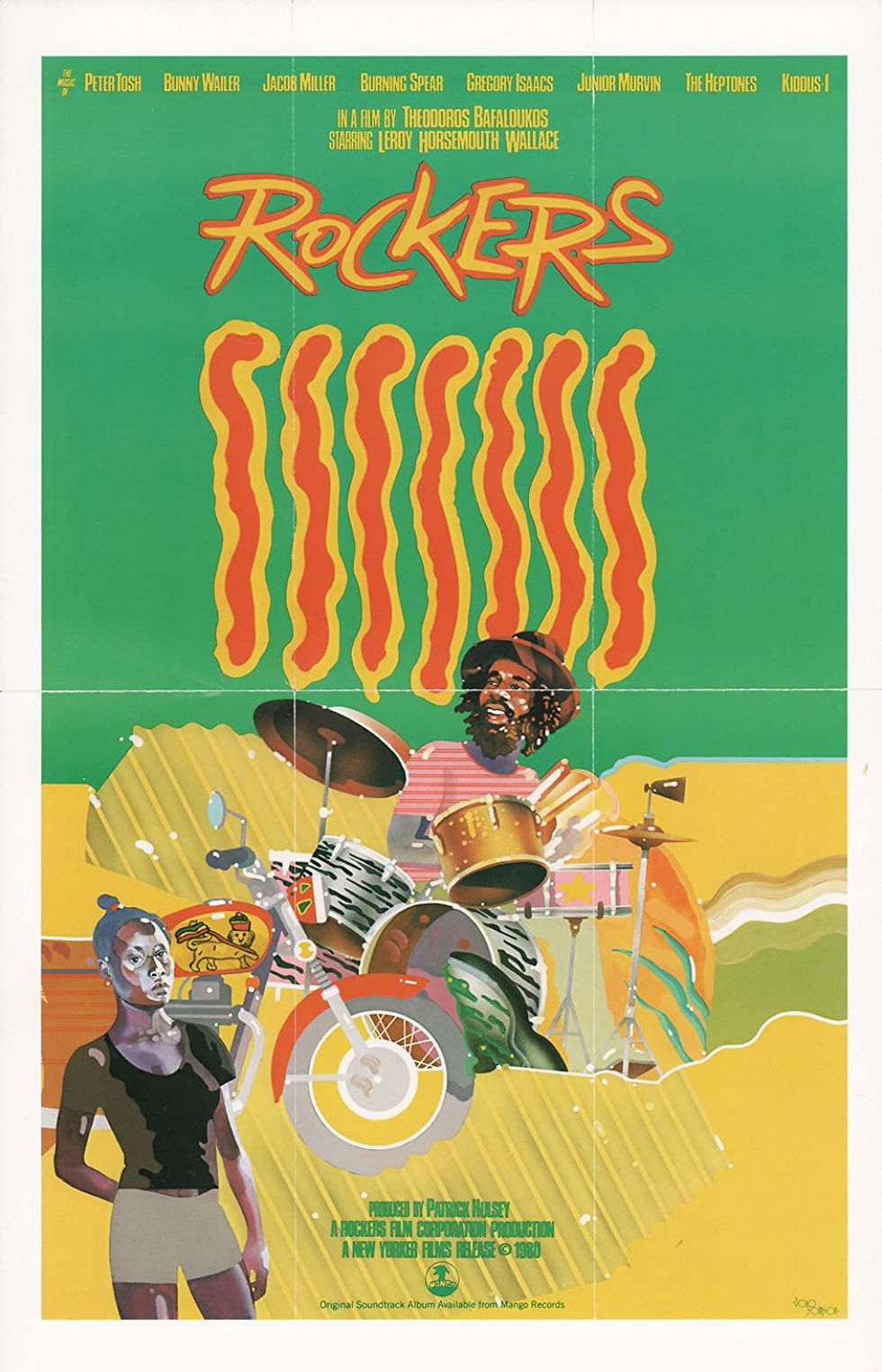
Given that Bafaloukos had spent over 2 years living intimately alongside the numerous reggae artists that were active in a creatively brimming mid-1970s Jamaica, it is unsurprising that the cast of Rockers reads as a roll call of some of the greatest names in reggae history. The plot centres on Horsemouth, who was considered one of Jamaica’s best drummers during the 1970s and who’d for many years worked alongside numerous reggae greats at arguably the island’s most iconic recording studio and record labels, Studio One. Alongside the movie’s protagonist, Gregory Isaacs, Jacob Miller, Kiddus I, Burning Spear and Big Youth all feature as themselves in the movie. A notable exception is that of Bob Marley, who Bafaloukos has said he didn’t approach out of a fear that his presence would lead his project to ‘become a film about Marley’ and thereby ‘overshadow the other musicians, who were his equals or better’.
Whilst The Harder They Come’s soundtrack has been credited as an integral album in bringing reggae to the US, Rockers’ is a classic reggae soundtrack in its own right. This is unsurprising given the vast number of reggae behemoths involved in the film; from Bunny Wailer to Peter Tosh, Gregory Isaacs to Junior Murvin, the album is an enthralling compilation of 1970s reggae classics. Incredibly, a plot to steal the film’s soundtrack tapes was thwarted when decoy boxes were loaded into Bafaloukos’s vehicle, testament to both the wild side of 1970s Jamaica and the acute excitement at the film and its accompanying album.
For me, the Rockers soundtrack feels more integrated within the movie than in The Harder They Come. The movie begins with a shot of Ras Michael and The Sons of Negus Nyabinghi drummers supporting the Abysinnians, who are singing their repatriation album, ‘Satta Massagana’, with further live performances including that of ‘Tenement Yard’ by Jacob Miller and ‘Graduation in Zion’ by Kiddus I. Whilst Cliff’s ‘The Harder They Come’ and Toots and the Maytal’s ‘Sweet and Dandy’ are both integrated in the recording studio scene, it feels like the music in Rockers is embedded more organically within the story. This is readily understandable given the relatively loose storyline and the numerous musicians involved in the story.

Rockers was released 6 years after The Harder They Come, and this age-gap seems to inform the artists who act in the movie and the music which makes up the film’s soundtrack. Whereas the discography of those artists involved in Rockers tends to begin in the early- to mid- 1970s, the big names involved in The Harder They Come tend to have began producing their significant works earlier in the 1960s, before reggae’s rise and when its precursors like ska and rocksteady were at the peak of their popularity. For example, Jimmy Cliff’s first album was released in 1967 and many of his earliest hits were ska rather than reggae; Toots and the Maytals were active for years before they gave reggae its name with their 1968 song ‘Do the Reggay’; and Prince Buster recorded some of the earliest ska releases like ‘Madness’ (1963) and ‘One Step Beyond’ (1964). This in turn influences the type of reggae in each film, with much of that in Rockers being exemplars of roots reggae rather than the emerging, early reggae of The Harder They Come. Both in terms of its lineal descendancy and musical characteristics, when it comes to reggae cinema, Rockers is the son and The Harder They Come is the father.
The Holy Spirit - Babylon (1980)

Whereas The Harder They Come and Rockers were both filmed in Jamaica and featured various Jamaican-born reggae stars in their casts, Franco Rosso’s Rockers was filmed almost exclusively in the streets of Deptford and Brixton during a short six-week shooting schedule and featured a number of important figures in British reggae. After the Father and the Son comes the Holy Spirit, and as a film instilled with the soul of reggae whilst being geographically disconnected from the genre’s spiritual home, Babylon fits the bill perfectly.
Following the death and destruction of the Second World War, the British government decided to incentivise immigration from its then-colonies to confront the severe labour shortages facing the country. Consequently, nearly half a million people from the Caribbean moved to the Britain from 1948-1970 in what has come to be known as the ‘Windrush generation’. Whether it be in terms of food, art, beliefs or music, these people brought not just their labour but also their culture. Consequently, as reggae developed in Jamaica and gradually increased its global reach, naturally many in the Jamaican diaspora created their own music, contributing to the reggae canon and in many cases innovating, using a Jamaican genre to reflect on their lives away from the island.
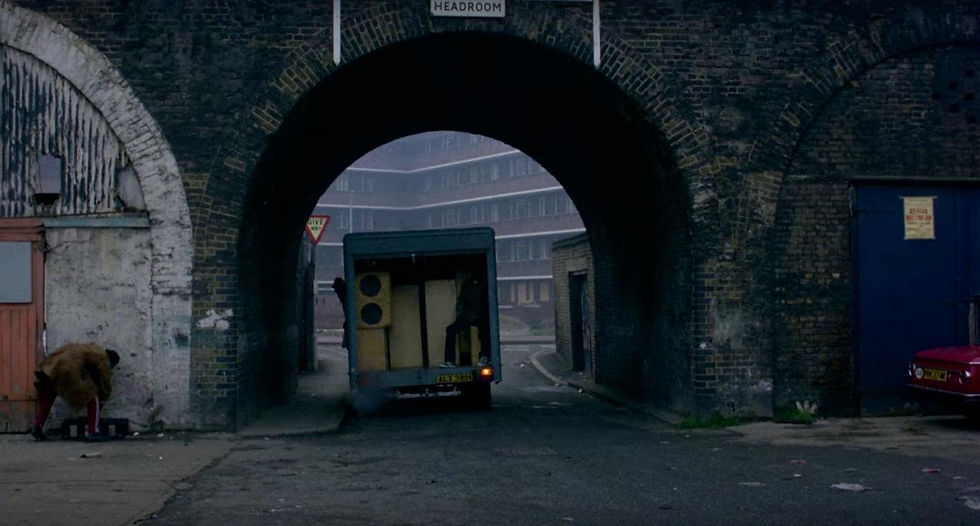
The film follows a young reggae MC, Blue, who along with his fellow members of the Ital 1 Lion sound system are preparing for a sound clash against Jah Shaka’s sound system. Babylon acts as an equal-parts provocative and captivating cinematic tour of Thatcher-era South London, presenting the richness and vibrancy of West Indian communities and
sound system culture, but also the extreme racism faced by West Indian immigrants at the hands of employers, neighbours, the National Front and the Metropolitan Police.
Just like Rockers avoided the idyllic beaches typical of orthodox representations of the Caribbean, Babylon sidelines traditional London landmarks in favour of more brutal, graffiti strewn derelict buildings. The only time we’re taken outside of South London is when a couple of Blue’s friends venture into the West End to trick and rob an unsuspecting gay man. The fact that London’s bright lights are shown just once for such nefarious means reflects both the disconnect of people like Blue from the glitz and glamour of central London and the cruel responses which such disenfranchisement can provoke in some.

Proof of the film’s raw social realism and challenging content came in the various difficulties its writers faced when trying to bring it to audiences in Britain and beyond. Babylon’s co-writers Franco Rosso and Martin Stellman initially presented the script to the BBC, however they eventually decided against working with the corporation after being asked to cut much of the script, partly due to time restraints but also as a result of its graphic subject matter, notably racial violence and police brutality. Further afield, the film was refused by the New York Film Festival as it was deemed to be excessively controversial and likely to incite racial tension. Amazingly, the cult classic wasn’t released in the US until 2019.

When the idea for the project began to take shape in the mid-1970s, Stellman was working as a freelance journalist and a community organiser in South London, setting up drama workshops for black and white working class teenagers. Much-like Bafaloukos was only turned on to reggae after experiencing Bob Marley perform live, it would take Stellman to be introduced to local reggae and dub acts by one of his students for him to become hooked on the music, turning him into a self-avowed reggae addict.
Stellman then started to bring his eventual Babylon co-writer to these events. Rosso had already made his directorial debut with The Mangrove Nine, an uncompromising documentary about community resistance to police attacks on the popular, black-owned Caribbean restaurant, The Mangrove. Notably, this story of police brutality, community solidarity and a battle for justice in late-1960s/early-1970s Notting Hill formed the basis for one of the films in Steve McQueen’s recent Small Axe anthology. Rosso and Stellman certainly stood out amongst the largely black crowd, indeed to the extent that they were often assumed to be undercover cops at gigs. Regardless, they burned a fire in the pair for the genre, a fire which would end-up being crystallised in Babylon.

Much as The Harder They Come and Rockers features key figures in the Jamaican reggae scene in their respective periods, Babylon features a number of the most prominent artists in the British dub and reggae scenes of the 1970s. The film’s protagonist Blue is played by founder member and frontman of the British reggae brand Aswad, Brinsley Forde, whilst the band’s drummer Drummie Zeb plays a more peripheral role as a doorman. Moreover, Victor Romero Evans, founder member of the Black Theatre Co-operative and reggae artist who recorded a number of Lovers Rock hits, plays the role of Lover. A number of Jamaican born artists also feature in the movie, including singer and producer Mikey Dread; musician King Sounds; and the late great sound system operator Jah Shaka.

The film’s soundtrack is anchored by Dennis Bovell, a reggae guitarist, sound system operator and dub producer who moved to South London from Barbados as a child in the 1960s. The soundtrack includes a number of Bovell’s own dub tracks, two Aswad songs and a selection of tunes from major Jamaican-born artists, including Yabby U’s ‘Deliver Me From My Enemies’ and I-Roy’s ‘Whap’n’Bap’n’. Forde, who’d secured the role of Blue through an open audition rather than by virtue of his musical achievements, claimed in an interview with Rolling Stone that Aswad only attained its space on the track-list after he repeatedly appealed to the producers: ‘Just to pacify me, I think, they said, ‘Ok, you do the dub.’’

Aswad’s ‘Warrior Charge’ is my personal favourite on the soundtrack. Peculiarly, when they shot the scene in which Blue introduces it to his fellow Ital 1 Lion sound system members, Forde hadn’t actually written the song yet, meaning they had to follow Forde’s lead and skank in silence to a non-existent rhythm. The final scene, partly based on a police raid made on Bovell’s own Sufferer’s Hi-Fi sound system in the mid-1970s for which he was falsely imprisoned, features Blue toasting over the Warrior Charge beat amidst a chaotic scene of onrushing police and dance-goers fleeing the room.
Almost 30 years after the film’s release, Dizzee Rascal got Forde to sing the hook of the final-scene's toast in his song ‘Can’t Tek No More’, highlighting that the release of Babylon on DVD in 2009 brought the film to a new generation. Whilst Dizzee Rascal got Forde to perform the hook on his song rather than sampling the original, all 3 reggae reggae films have been the subject of numerous samples. From dub group Dreadzone’s sample of a Horsemouth speech preaching the fall of Babylon in ‘Zion Youth’ through to Chase & Status’ sample of Hilton, the record mogul in The Harder They Come, in their song ‘Hitz’, it seems these 3 movies have not just been vehicles for a cinematic expression of the reggae spirit but also sources of inspiration for subsequent generations of musicians outside of the genre.


Comments