The King of Afrobeat and his 27 Queens
- Jack Curson
- Dec 8, 2023
- 9 min read

Jack Curson

Fela Kuti, the iconic Nigerian musician-cum-political activist, is renowned in his homeland of Nigeria, his beloved-continent of Africa and across the world as the maverick pioneer of Afrobeat. Afrobeat is a distinctive Nigerian music genre which combines the West African musical styles of highlife, itself a hybrid of traditional African metre and Western jazz, and more traditional Yoruba and Igbo music with the funk, soul and jazz influences of black America. The genre has had a huge impact globally and continues to be produced across the world, however its evolution is indelibly linked with its founder, Fela Kuti. Behind the music, Fela’s life is an incredible story. Beginning with his upbringing in a middle-class Nigerian family, Fela went through a process of political and musical enlightenment to become a leading Nigerian cultural icon, as well as a sworn political enemy of the country’s military government. Possibly most remarkably of all, at the height of his popularity, Fela married 27 of his female band members in a traditional Yoruba ceremony. A story of musical brilliance, political avtivism and individual extravagance - this is the life of the King of Afrobeat.
From the Establishment to Enlightenment

Fela was born into the well-respected, upper-middle class Ransome-Kuti family in the British Colony of Nigeria in 1938. His father, Israel Oludoton Ransome-Kuti, was an Anglican minister, educator and the first President of the Nigerian Union of Teachers, whilst his mother, Funmilayo Ransome-Kuti, was a renowned political campaigner who played a key role in the Nigerian women rights and national independence movements of the 1940s and 50s. His brothers Beko and Olikoye both became doctors and were known across Nigeria as a human rights activist and Minister of Health respectively, whilst his cousin Wole Soyinka would go on to win the Nobel Prize in Literature. It was from this family, made up of renowned individuals that would play important roles in the formative decades of an independent Nigeria, that one of the country’s most famous dissidents would originate.

After receiving a first-class education in Nigeria, in 1958 Fela was sent to London to study medicine. However, in defiane of his family's expectations, he chose to pursue his passion for music and enrolled in the Trinity College of Music. Whilst studying in London Fela married his first wife, the British-born Nigerian Remilekun Taylor, who mothered his first 3 children. The couple would divorce soon after they moved to Nigeria with their young family in 1963. On his return home, Fela trained to become a radio producer and played in various bands, becoming a popular figure in the Lagos music scene without approaching the national and international acclaim he would during the 1970s and beyond.

It was in 1969, when Fela and his band Koola Lobitos travelled to the US for 10 months, that Fela experienced a dramatic musical and political transformation. Whilst stateside, Fela met Sandra Smith, a singer and former Black Panther, who introduced him to the politics of black militancy and the writings of black activists, like Angela Davis, Eldridge Cleaver and Malcolm X. Whilst reflecting on his time in the US, Fela said: ‘everything fell into place…For the first time, I saw the essence of blackism… All these Americans come over here [Africa] looking for awareness. They don't realise they're the ones who've got it over there. Why, we were even ashamed to go around in national dress until we saw pictures of blacks wearing dashikis on 125th Street.’ As well as radicalising him politically and alerting him to the neocolonial grip that was being exerted on his homeland, Fela’s trip further exposed him to the music of Black America, music which would form a key part of his Afrobeat sound.
Musical Maverick and Political Activist

Soon after returning home from the US in 1970, Fela Africanised his family name, replacing Ransome, which he had come to consider to be a slave name, with Anikulapo, meaning ‘one who carries death in his pouch’ in Yoruba, with the intimation that: ‘I will be the master of my own destiny and will decide when it is time for death to take me’. At the same time Fela, along with his renamed band Africa 70, began his unique fusion of the music of Black America and West Africa that would form the foundations of Afrobeat. Fela set up his own nightclub named the Shrine, where as well as performing throughout the night alongside his band, Fela also officiated traditional Yoruba religious ceremonies in honour of his ancestral faith.

At the same time, the lyrical themes of Fela's songs moved from a tendency to focus on love to more social and political issues. Fela described his music as a ‘weapon’ from which he could attack the exploitation of the Nigerian people at the hands of the corrupt military government and commercial elites. Singing in Pidgin English as a means of accessing the greatest number of people in a continent saturated with a vast diversity of languages, in his songs Fela condemned the beneficiaries of colonialism for continuing to drain the newly independent nations of Africa of their wealth and resources.
From 1966-1999, with a brief interregnum from 1979-1983, Fela’s native Nigeria was a military dictatorship in which various coups, aided by the tacit support of the country’s elites, periodically brought different factions of the Nigerian Armed Forces to power. It was in this authoritarian political context that Fela began producing his highly provocative music, which, unsurprisingly, was banned on all government radio stations. Fela would be arrested on over 200 different occasions during his life and was subject to countless beatings at the hands of state forces.

In an act of defiance, on his return from the US Fela declared his sprawling communal compound in the outskirts of Lagos to be independent from the Nigerian state. The complex, whih Fela named the Kalakuta Republic, housed a recording studio and a free health clinic, as well as acting as a sanctuary for many members of Africa 70 and the broader entourage connected to Fela and his band. Predictably, the Kalakuta Republic was subject to countles raids at the hands of state forces.

In 1976, Fela and Afrika 70 released their iconic album Zombie, which used the metaphor of a zombie to attack the Nigerian military and their mindless, brutal violence. Whilst the album was a huge hit with the Nigerian people, it predictably infuriated the military, prompting them to unleash their most brutal attack on the Kalakuta Republic to date, with 1000 soldiers raiding the commune on the 18th of February 1977. During the raid, Fela and his cohabitants were brutally beaten, many of the women in compound were raped, and the commune was burnt down to the ground. Most shockingly of all, Fela’s 77-year old mother, a icon of the feminist and independence movements, was thrown out of a second-floor window. She was hospitalised and would die around a year later as a result of the injuries she suffered during the violent attack.

Fela commemorated the one-year anniversary of his mother’s death by delivering a coffin to the Dodan Barracks in Lagos, the headquarters of Nigeria’s Supreme Military and the official residence of head of state General Olusegun Obasanjo, who, ironically, attended the same primary school as Fela. Later, Fela further shamed the government by recording a new album titled Coffin for the Head of State, which included the title track which berated ‘big fat stomach’ Obasanjo and another song, Unknown Soldier, in reference to the official inquiry’s false claim that an unknown soldier had destroyed the commune.
The King and his Queens

It was as another part of the commemorations of the attack on the Kalakuta Republic that Fela famously married 27 of his female band members. Part of the reason for the marriage was the fact that the authorities had repeatedly made false claims that Fela had kidnapped the women living with him as a means of justifying their raids on the commune. Moreover, the women had been labelled as drug-addicts and prostitutes. In this way, the marriage was a means of protecting Fela and the women he lived with from both the government’s violent raids, as well as attacks on their honour. In the words of Laide Babayale, one of Fela’s 27 wives, ‘Fela loved us and was not happy with the way people were treating his women. He married us because he wanted to make us proud; he did not want us to be disgraced.’

The marriage can also be seen as part of Fela’s broader project, evident across both his music and his politics, of re-asserting African tradition. In this way, the polygamous arrangement can be understood as a way of asserting Yoruba identity in opposition to the predominantly Christian Nigerian establishment, a product of the Westernisation which was imposed upon Nigeria at the expense of indigenous customs and practices. Alongside this, Fela also advocated polygamy as a logical arrangement given the perceived predilections of men: ‘A man goes for many women in the first place. Like in Europe, when a man is married when the wife is sleeping, he goes out and sleeps around. He should bring the women in the house, man, to live with him, and stop running around the streets!’

Whilst the marriage was reasoned in a number of ways, Fela’s overtly misogynistic views leaves open the argument that Fela’s polygamy was a product of his regressive sexual politics. Despite his mother being a prominent champion of women’s rights, Fela openly espoused sexist views. In the 1972 single Lady, Fela criticised modern feminism for presenting women as the equals of men, asserting that ‘Lady na master’. Moreover, in an interview Fela declared, 'To call me a sexist . . . for me it's still not a negative name. If I'm a sexist, it's a gift. Not everybody can fuck two women every day. ‘
However, in Fela and His Wives: The Import of a Postcolonial Masculinity, Derek Stanovsky argues that linking Fela’s overt misogyny and his advocation of polygyny is problematic. Stanovsky asserts that an essentially misogynisy authentic native masculinity is constructed, a masculinity for which Fela’s belonging is questionable given his background as the son of an Anglican priest in an elite family, which feeds into the Western conception of Black African men as hyper-sexual. This is deployed to explain how an otherwise progressive political and cultural figure could slip into recessive, conservative views on women. From this perspective, allying Fela’s overtly misogynistic views with his advocacy of polygyny overlooks the way in which polygyny may be viewed as a tool of resistance against imposed Christian orthodoxy.
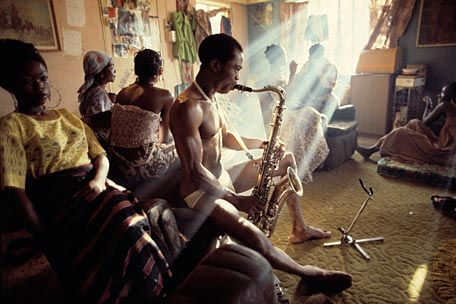
The marriage had originally been planned to take place at Fela’s lawyer’s office to mark the one-year anniversary of the attack on the Kalakuta Republic. However, after this plan failed to materialise, it was on the 20th of February 1978, exactly a year and 2 days after the government’s notorious attack on their home, that Fela married 27 of his band’s dancers, composers and singers. The marriage was a traditional ceremony, conducted with the blessing of 12 Ifa priests at the Parisona Hotel in Lagos. After the marriage, Kuti and his wives went on honeymoon in Ghana, and on their return Fela established a rotation system of 12 wives at a time.
The King is Dead, Long Live the King

1978 proved to be a turbulent year for Fela, being marked by 2 notorious concerts. The first, in the Ghanaian capital of Accra, led to Kuti being banned from the country after riots broke out during the performance of Zombie. Later in the year, after a performance at the Berlin Jazz Festival, almost all of Africa 70’s musicians resigned, having been disappointed by their fees amidst rumours that Fela was planning to use proceeds from the band’s performances to fund his own political ambitions. This led Fela to form a new group named Egypt 80, reflecting his conviction that all of Egyptian civilisation’s history, philosophies and knowledge must be considered African and an indelible part of the continent’s own history.

From 1979-1983 there was a brief pause in the military’s rule over Nigeria, during which Fela entered the country’s political arena. He formed the Movement of the People political party to ‘clean up society’, with the party preaching Africanism and Nkrumahism, the distincitvely African socialist political ideology of Ghana’s first president, Kwame Nkrumah. Fela even nominated himself to become Nigeria’s president, however his candidature was refused by the election board.
This brief period of limited political freedom came to an end when Muhammadu Buhari overthrew the short-lived Second Republic in 1983, re-establishing military rule over the country. True to form, Fela was a vocal critic of Buhari and the military’s rule over the country, though this new incarnation of military government refused to tolerate Fela’s political activism. In 1984, he was jailed by Buhari’s government on a charge of currency smuggling, despite denunciations of the charges as being politically motivated by Amnesty International and a host of other human rights groups.

In 1986, after 20 months of imprisonment, the country’s new leader, General Ibrahim Babanguda, released Fela from prison. In Yoruba tradition women can divorce their husband whenever they wish to, so many had moved on even before Fela had been imprisoned. However, on his release Fela divorced his remaining wives, claiming that the competition between them to garner his affections proved that ‘marriage brings jealousy and selfishness’. However, none of his ex-wives were forced to leave his home after the divorce, with some living alongside Fela until his death over a decade later.
Fela continued to release music after being freed from prison, although his output slowed in the 1990s, particularly once he began suffering the effects of AIDS. Whilst his brother Olikoye was a prominent AIDS activist, in Condom Scallywag and Scatter, Fela’s last recorded song, he problematically condemned condoms as un-African and referred to AIDS as a white man’s disease. In 1997, at the age of 58, Fela died from an AIDS-related illness, a death which, despite his views, helped to elevate awareness of AIDS across Africa.
Fela’s legacy is a complex one, characteristic of a complex character. Fela’s political radicalism veered from a powerful advocacy for African solidarity and popular empowerment amidst unrelenting political oppression, all the way to dangerous AIDS denialism and overt sexism. Whilst his personal legacy may be contentious in parts, what remains indisputable is the legacy of his work, work which is underpinned by Fela’s unrelenting commitment to his core values of solidarity and resistance, and insatiable musical experimentation and fusion.


Comments